Generate more qualified inquiries
Generate more qualified customer inquiries.
CoolFox Refrigerated Vehicles
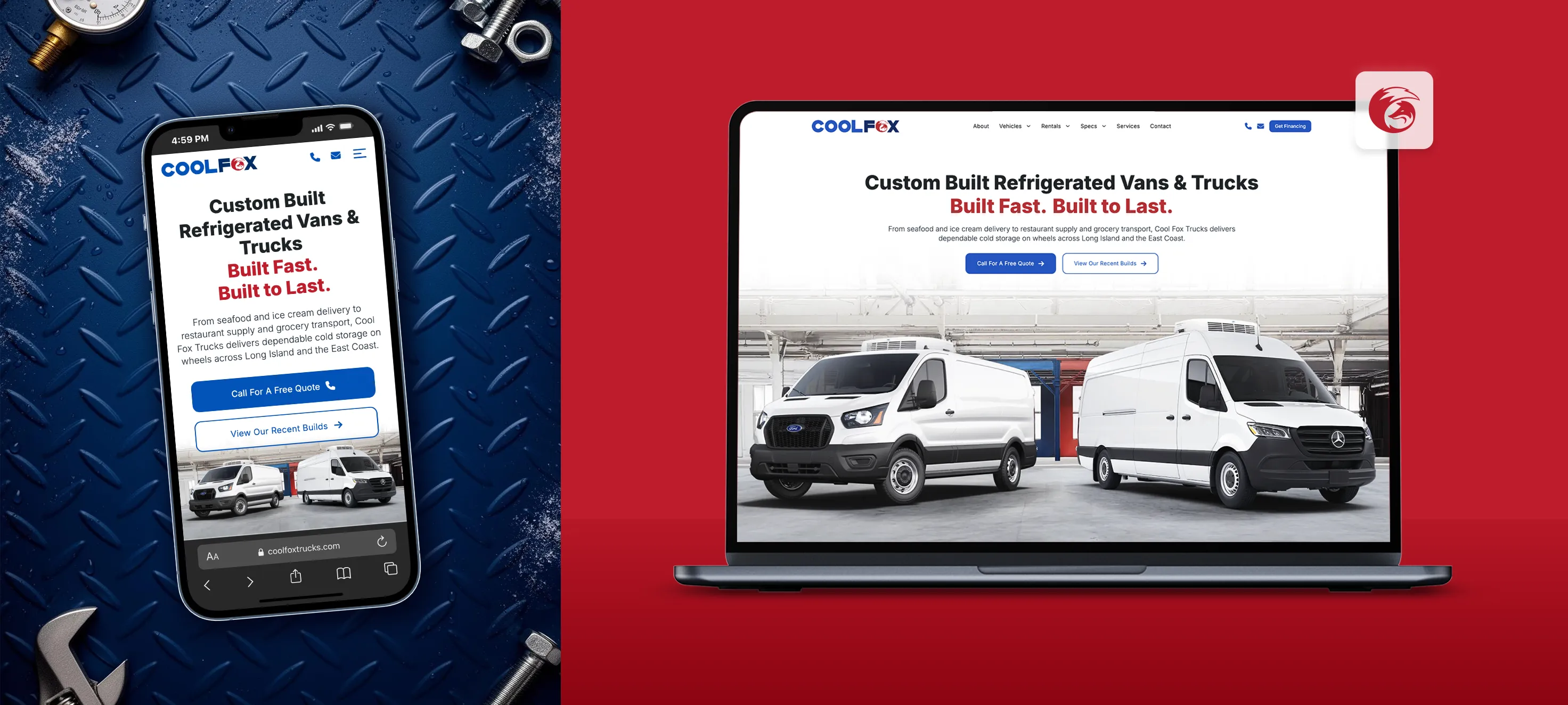
Cool Fox builds custom refrigerated vehicles for specialized commercial needs. I redesigned its digital experience to make vehicle discovery easier, clarify the company's value, and create more direct paths from consideration to inquiry.
Overview
Cool Fox had built a highly specialized business around custom refrigerated vans, trucks, and trailers, but its website did not communicate that same level of expertise. Information was difficult to scan, navigation did not clearly support customer intent, and prospective customers lacked an obvious path from understanding the offering to finding the right solution and making an inquiry.
Generate more qualified customer inquiries.
Quickly understand which refrigerated vehicle solution fits their operation.
Create a clearer path from discovery to evaluation to contact.
Experience Audit
I reviewed the existing site across navigation, content hierarchy, product discovery, credibility, and conversion pathways to identify where the experience was creating unnecessary friction for prospective customers.
Six findings shaped the redesign. Select the blue plus hotspot on any screen to read the detail behind it.
Finding 01
Finding 01
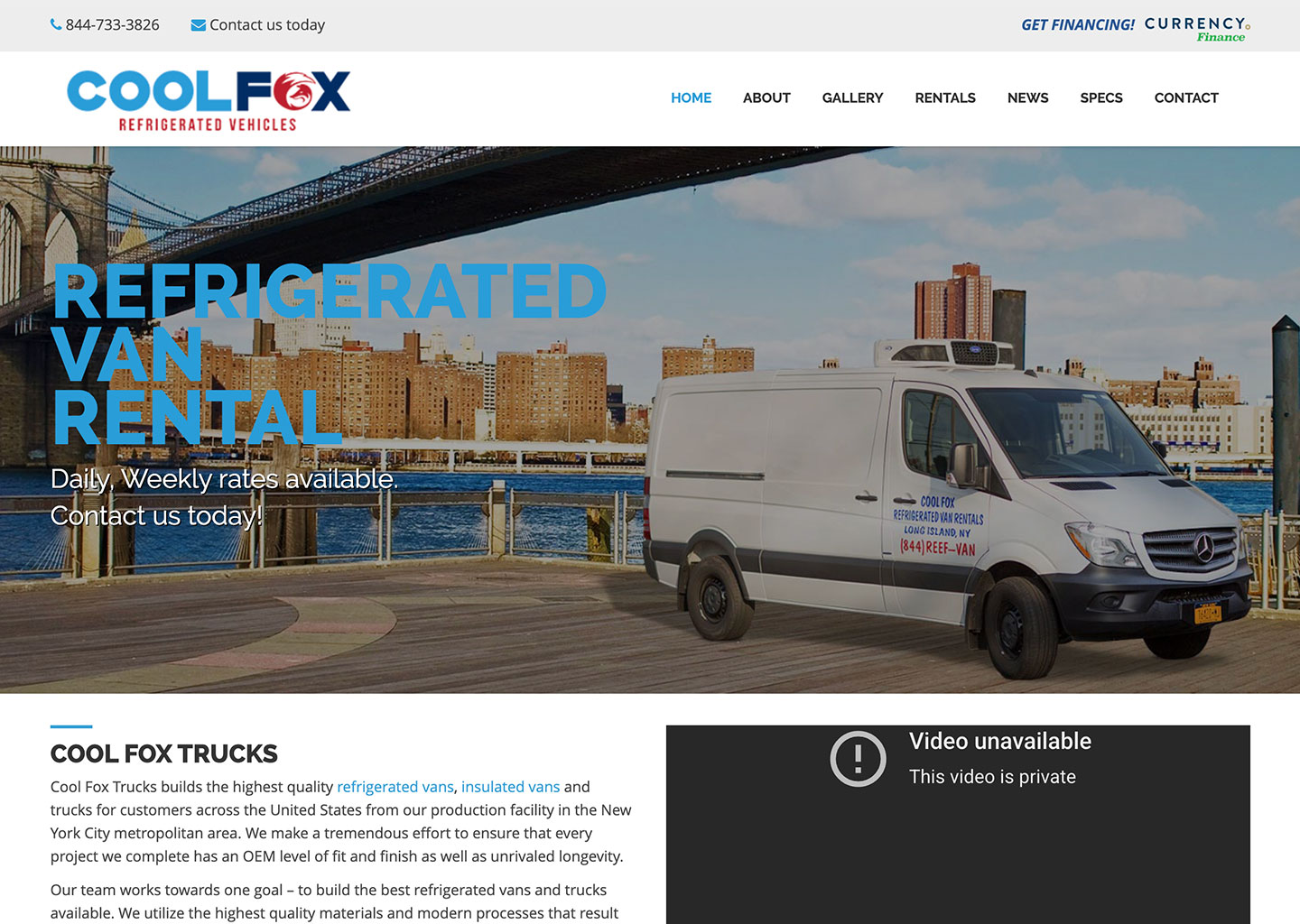
The homepage led with a rotating carousel of marketing messages, so nothing established what Cool Fox builds or why it is different. Visitors could read a lot, but the page never resolved into a primary action such as exploring vehicles or requesting a quote.
Finding 02
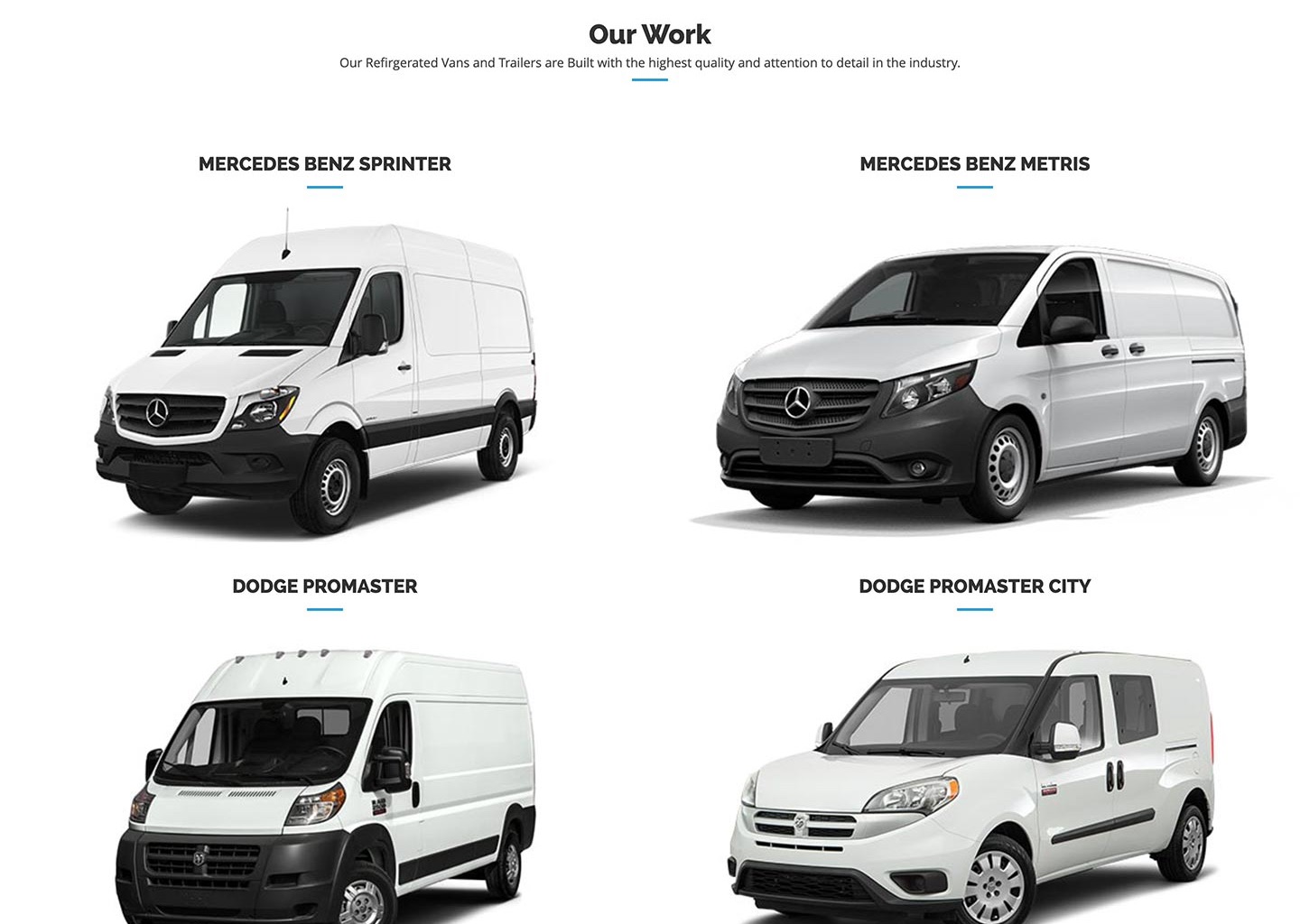
Finding 02
Dense content and an inconsistent spacing scale left every element competing for the same level of attention. Without a reliable hierarchy, visitors had to read sections in full to work out which parts were relevant to them.
Finding 03
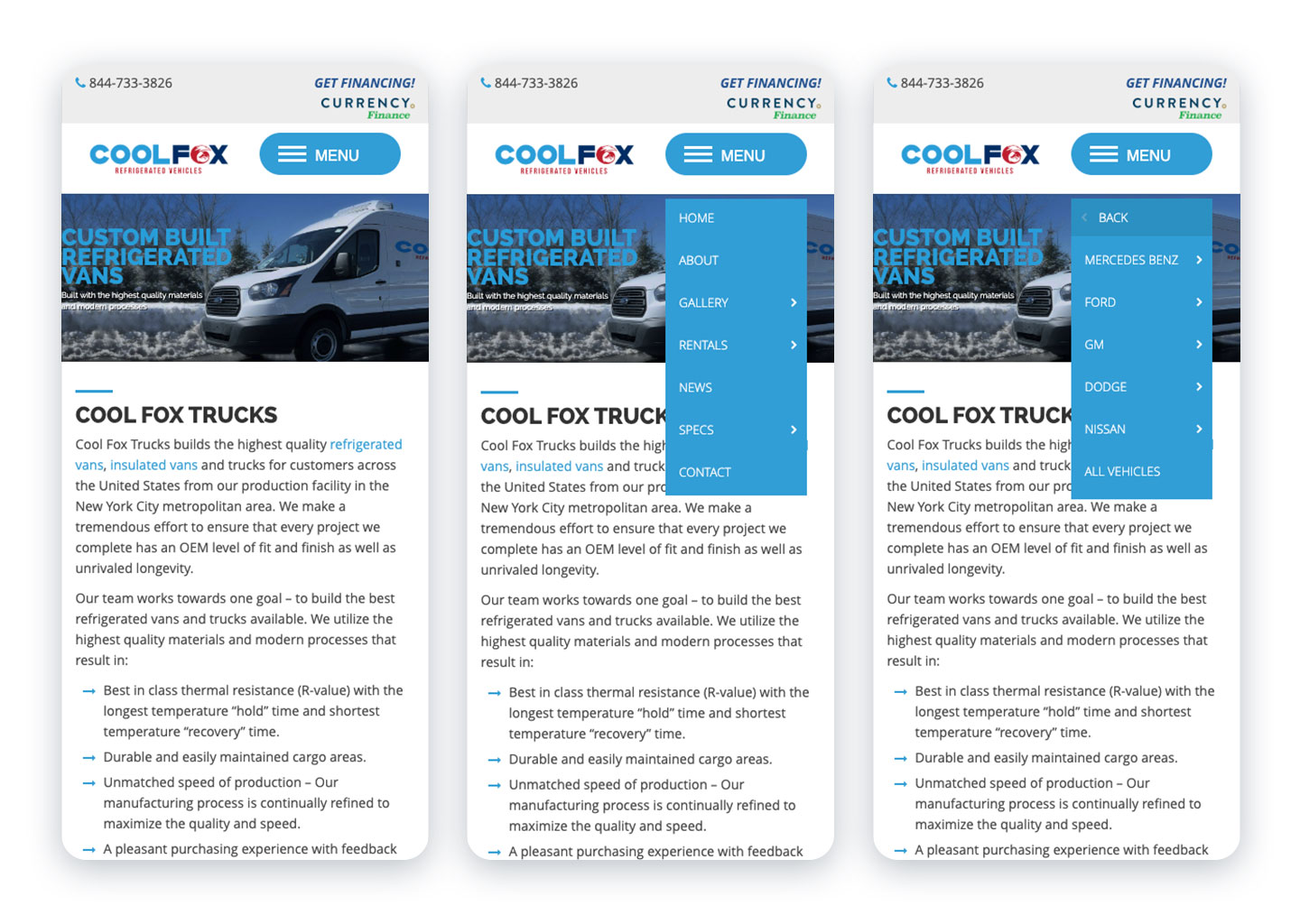
Finding 03
Reaching a relevant vehicle meant first understanding Cool Fox's site structure and internal terminology. On mobile this was sharpest: categories, rentals, and specifications sat behind a narrow menu that made comparison difficult.
Finding 04
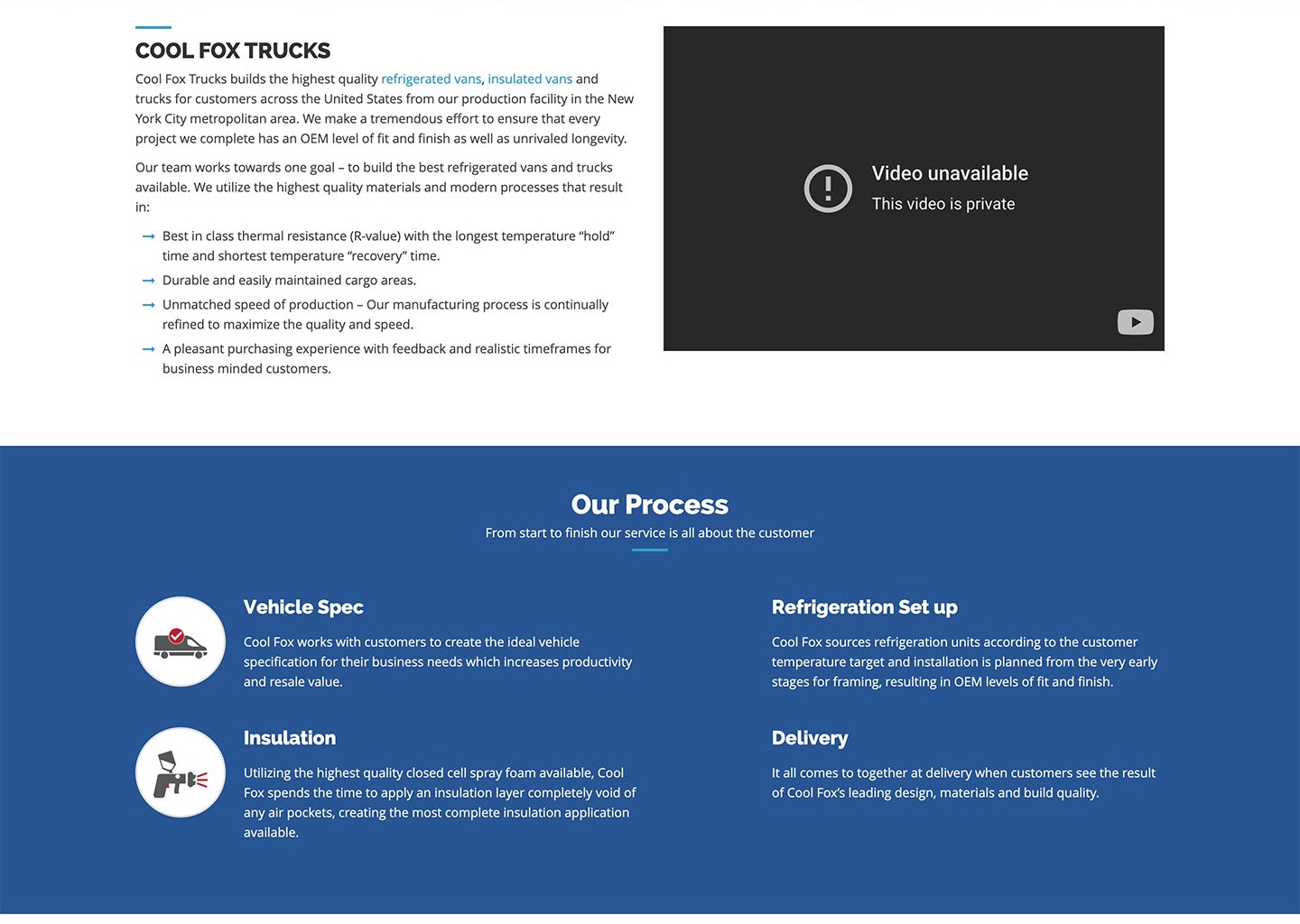
Finding 04
The site offered little of what customers actually weigh before inquiring: capabilities, customization, the build process, or answers to common questions. A broken video below the hero left a further gap where explanation should have been.
Finding 05
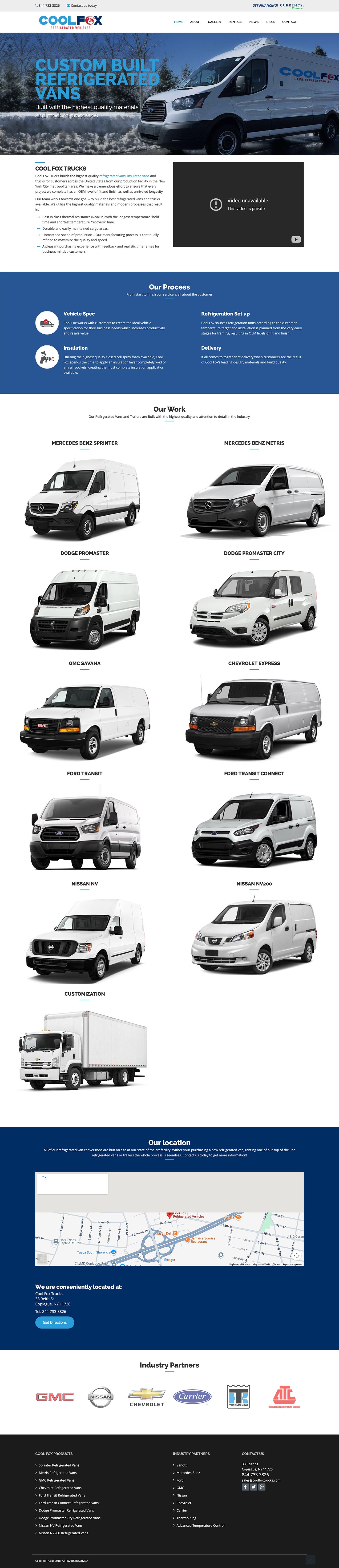

Finding 05
The original site carried no testimonials, certifications, or industry affiliations anywhere. Customers weighing a high-cost custom build had nothing to reassure them at the points of highest hesitation.
Finding 06
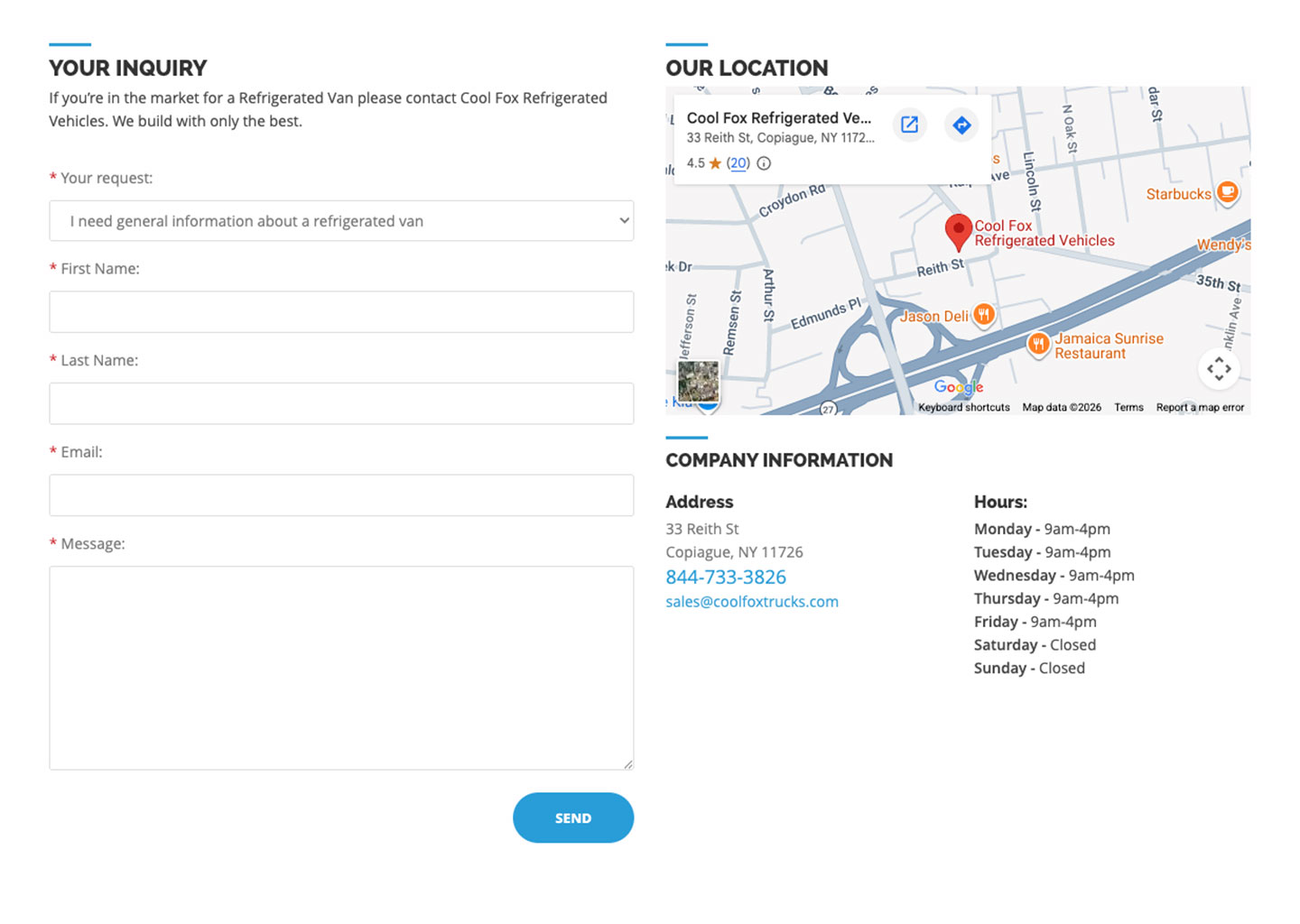
Finding 06
Calls to action existed, but the site did not consistently guide customers toward a quote or a conversation. The contact page also led with a form, while nearly all real inquiries arrived by phone or email.
Customer Needs & Hypotheses
Without formal customer research available, I combined the existing-site audit, business requirements from the owner, a review of the competitive landscape, and the behavior implied by the sales journey to establish a set of redesign hypotheses about what customers needed from the experience.
Competitive Landscape
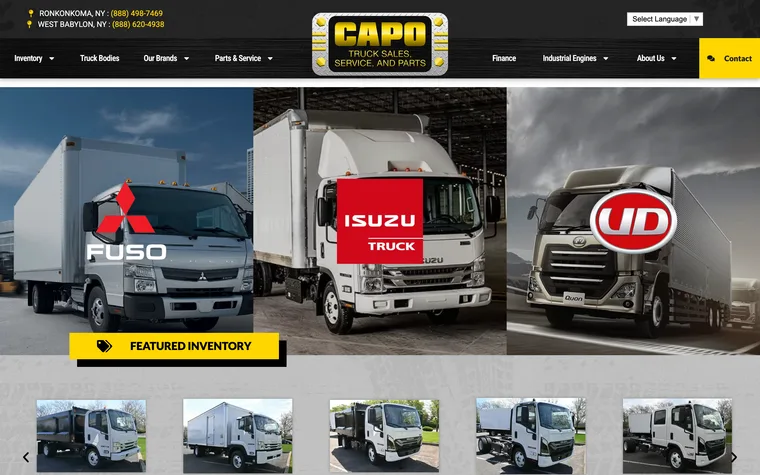
I reviewed four regional competitors to understand how the category supports vehicle discovery, communicates technical offerings, establishes trust, and moves customers toward inquiry.
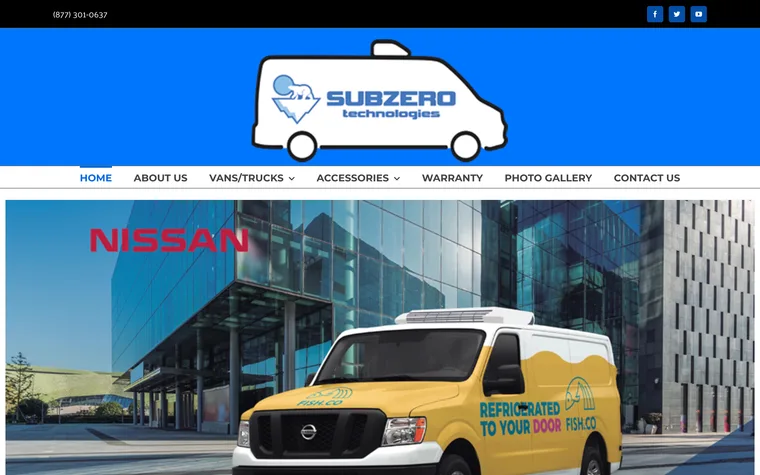
Vehicle discovery Limited
Benefits over specifications Partial
Trust & build proof Strong
Clear next step Partial
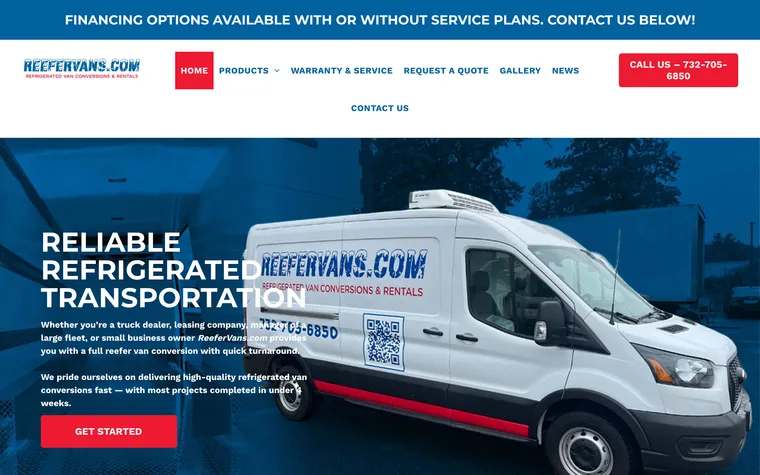
Vehicle discovery Partial
Benefits over specifications Strong
Trust & build proof Strong
Clear next step Strong
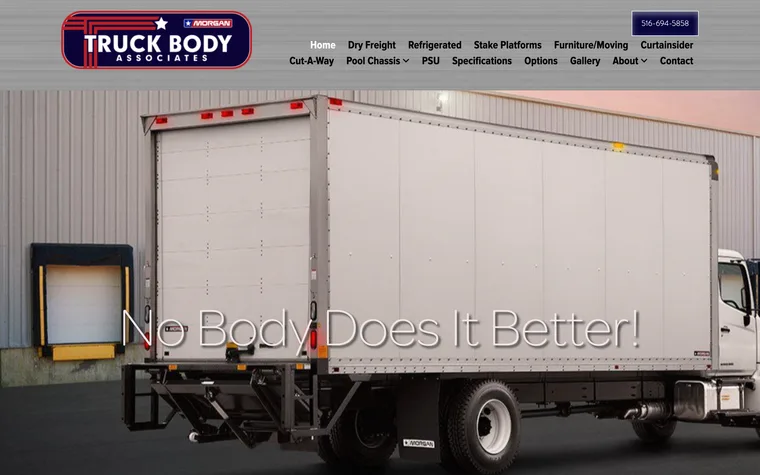
Vehicle discovery Limited
Benefits over specifications Partial
Trust & build proof Partial
Clear next step Partial
Vehicle discovery Limited
Benefits over specifications Limited
Trust & build proof Partial
Clear next step Strong
Ratings reflect a review of each published site, not internal capability.
Customer Needs
I found that the category largely organizes information around products, configurations and technical specifications — an opportunity to organize Cool Fox’s experience around the customer’s decision process instead.
Four hypotheses follow, sequenced the way a customer actually moves through the decision.
Customers need to quickly determine which vehicle type or configuration fits their operation, without first learning how Cool Fox organizes its catalog.
Product information should make it easy to evaluate capabilities and customization without overwhelming the customer with specifications.
A custom refrigerated vehicle is a significant investment, making expertise, craftsmanship, and visible proof especially important.
Inquiry should feel like the natural next step in the buying journey rather than an unrelated contact form at the end of the site.
Information Architecture
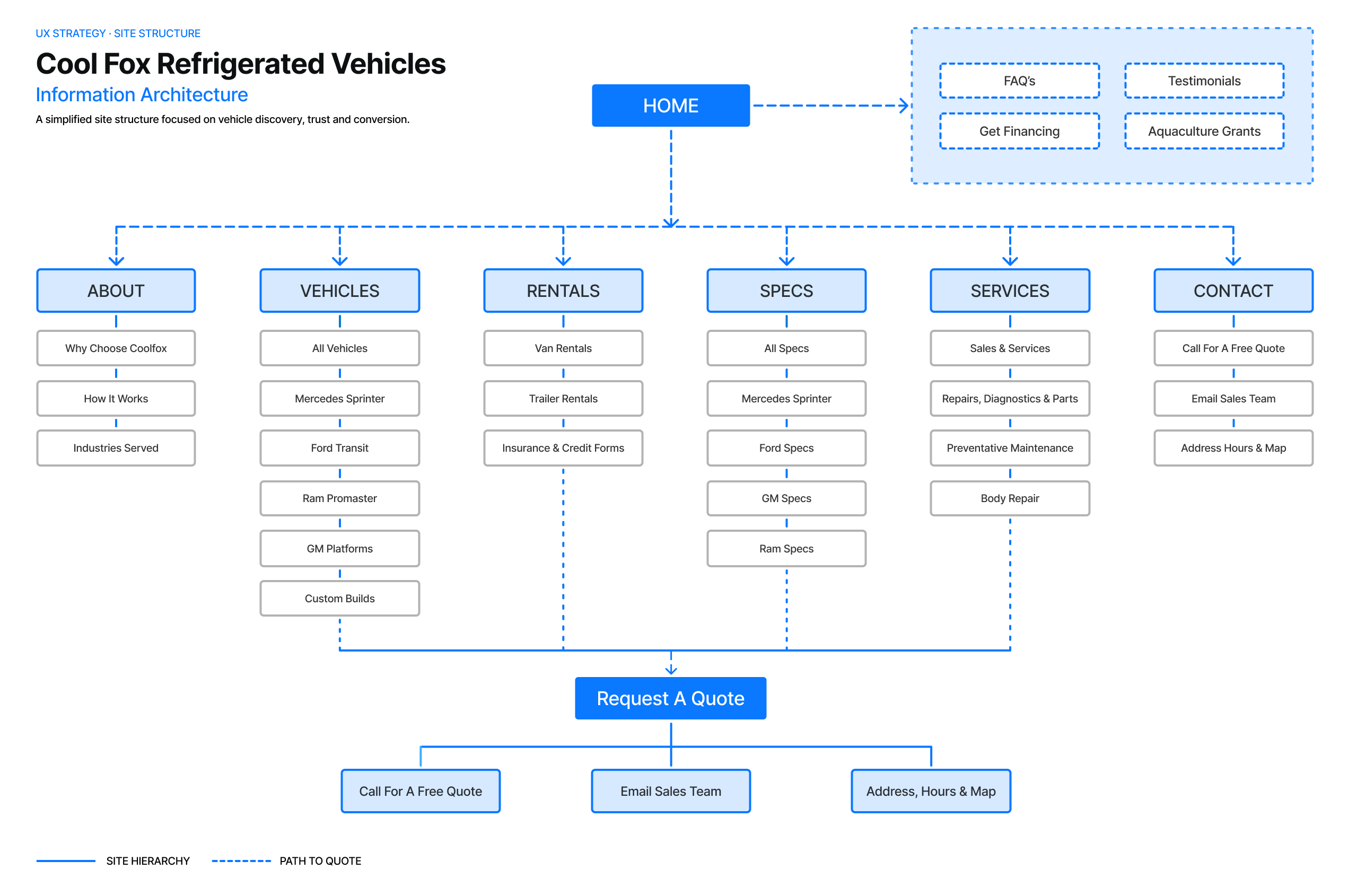
I connected vehicle discovery, capabilities, supporting proof, and inquiry into a more intentional decision journey. Instead of expecting customers to understand Cool Fox's internal site structure, I built pathways based on what customers are trying to accomplish.
Clarify the offer immediately Make it obvious what Cool Fox builds and who it serves.
Organize around customer intent Help visitors reach relevant vehicle and service solutions using recognizable choices, so discovery relies on recognition rather than recall.
Build confidence through exploration Use product detail, craftsmanship, capabilities, and proof to reduce uncertainty.
Create a continuous path to inquiry Surface quote and contact opportunities as customer intent increases, moving high-intent customers straight into a conversation with the business.
The Solution
Rather than reorganizing pages, I structured the experience around the questions customers ask in order: what does Cool Fox build, do they have something for my business, can they customize it, why should I trust them, and what happens next. Each screen below answers one of those questions at the point it comes up.
Select the blue plus hotspot on any screen to see the decision behind it.
Solution 01
Design detail
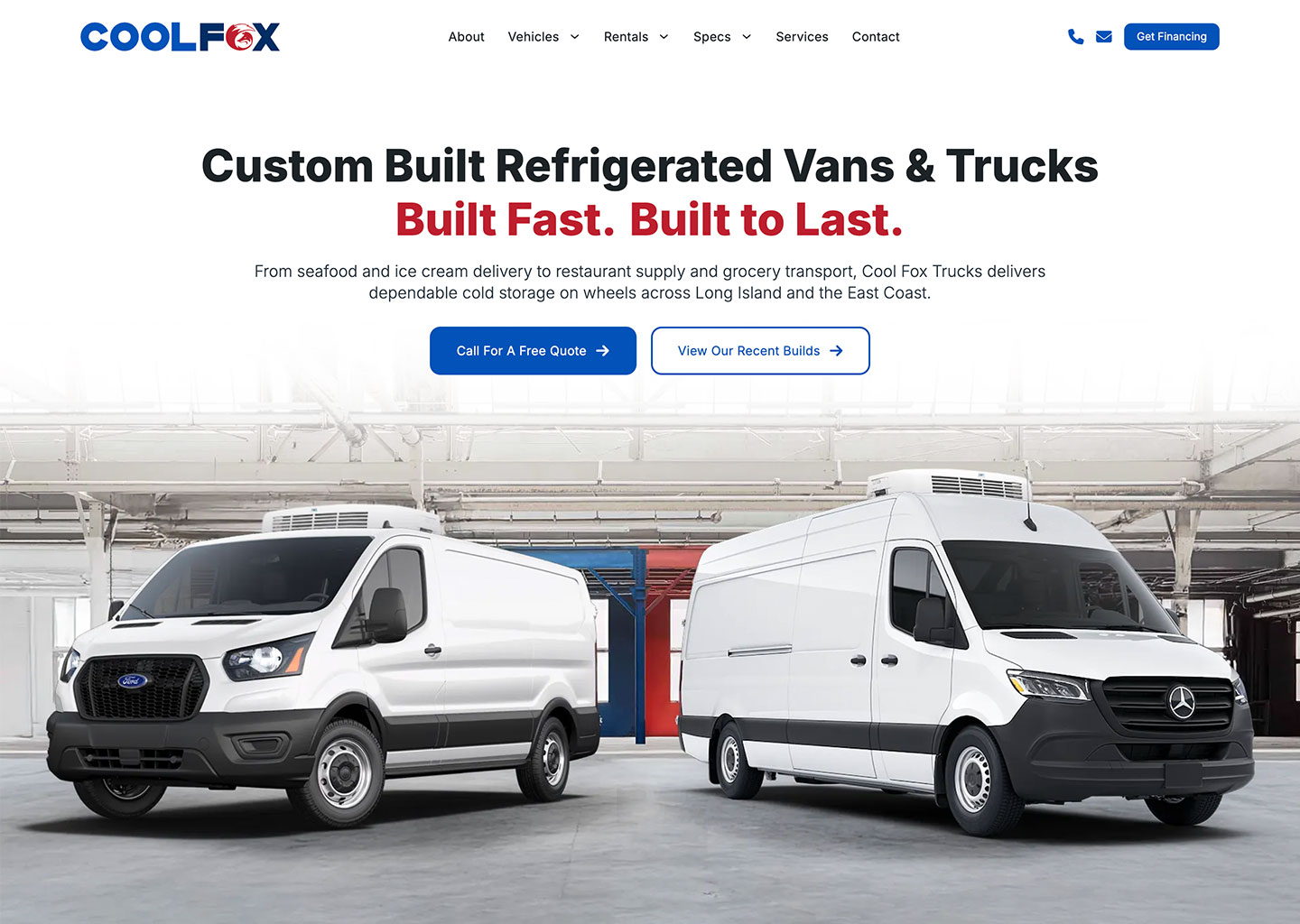
The carousel was replaced with a single value proposition and two actions matched to two levels of intent. Call For A Free Quote resolves to whichever contact method suits the device: on desktop it moves the visitor to the contact section, where a form and full details are easier to work through, and on mobile it opens the dialer, since someone already holding a phone is one tap from the conversation. View Our Recent Builds answers the strong visitor interest in completed work, letting customers judge craftsmanship before committing. On mobile the secondary action stacks below, keeping the same priority.
Solution 02
Design detail
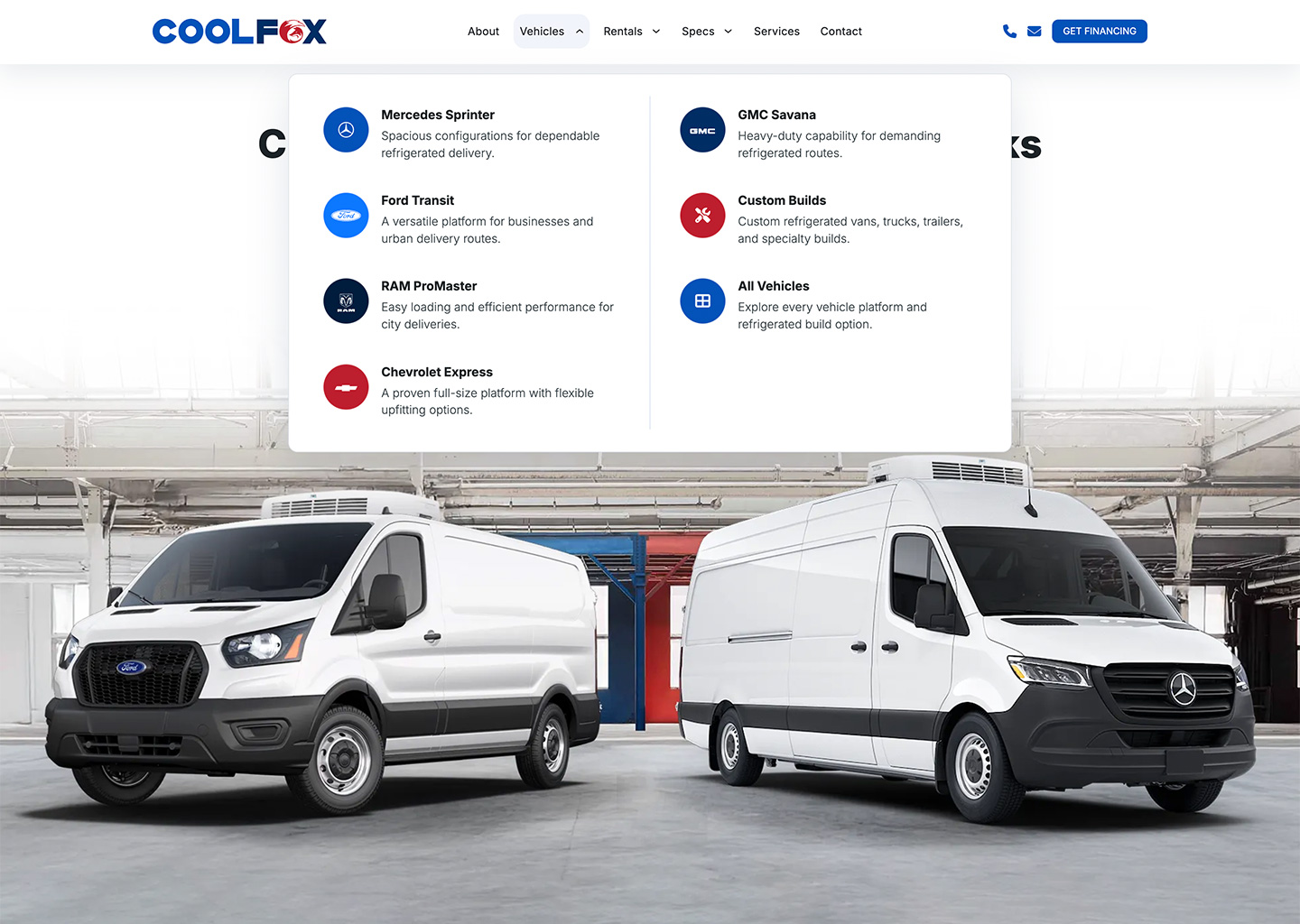
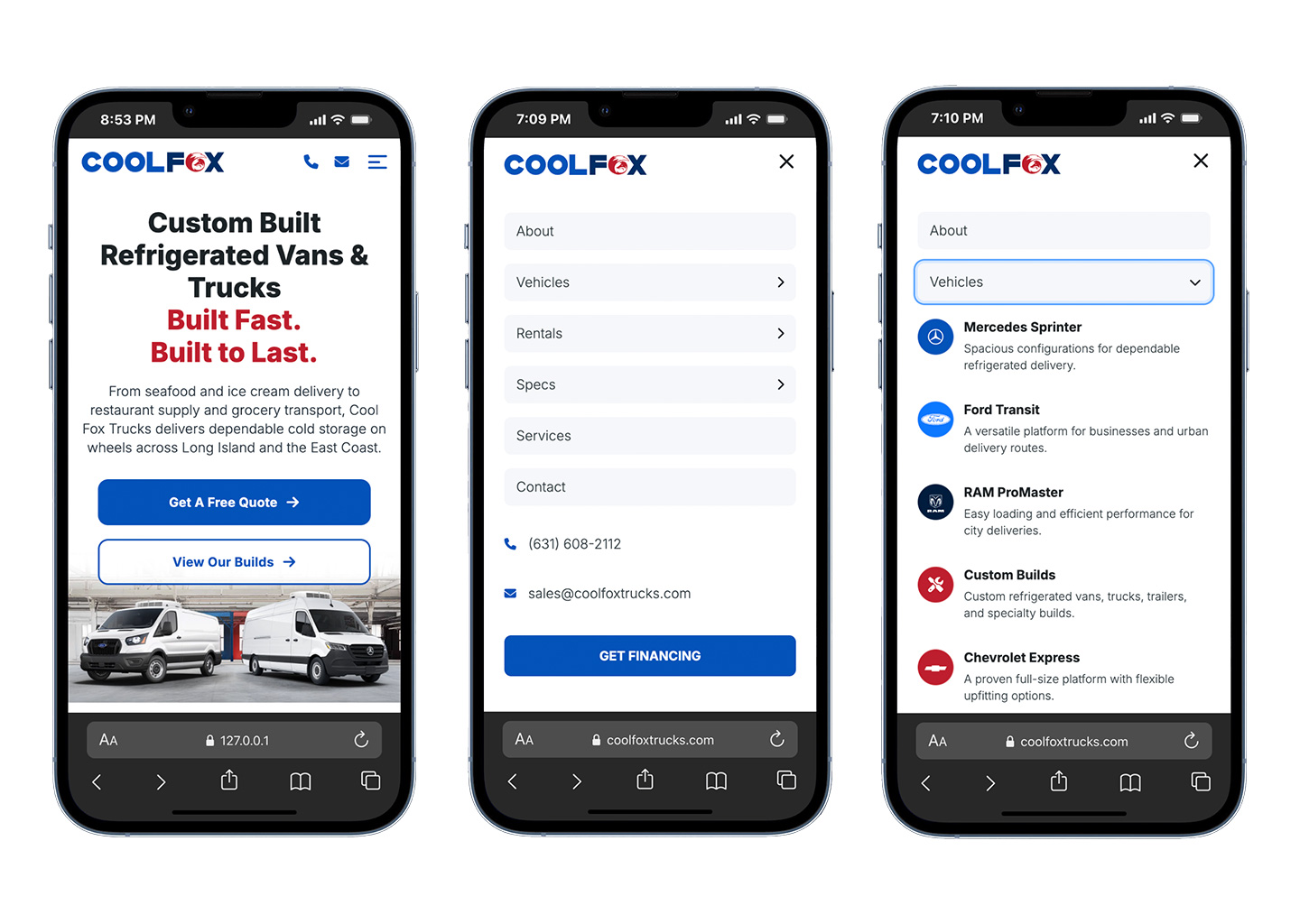
Navigation was regrouped around what customers are looking for, and the drill-downs pair each vehicle platform with its manufacturer mark. Familiar marks work as visual landmarks, so customers recognize the platform they already have in mind instead of reading every option, favoring recognition over recall. They also signal the range of commercial platforms Cool Fox builds on, adding confidence during evaluation.
Solution 03
Design detail
The same discovery model carries to mobile as an off-canvas menu with expandable drilldowns, so moving between vehicle categories, rentals, specs, and services does not cost the visitor their place. Manufacturer marks carry through the same way, keeping discovery recognizable on a smaller screen. Contact and financing stay visible throughout.
Solution 04
Design detail
In a category of specification-heavy competitors, the decision usually turns on a handful of factors: lead times, insulation quality, durability, and local service support. Giving these a dedicated section makes the comparison legible at a glance instead of buried in specs.
Solution 05
Design detail
Uncertainty about the process is a reason first-time buyers delay inquiring. Breaking the build into four visible stages, from consultation to delivery, sets expectations before contact rather than after it.
Solution 06
Design detail
Customers think in terms of their operation, not vehicle categories. The industry selector lets visitors start from what they haul and arrive at the relevant configuration, removing a step of interpretation.
Solution 07
Design detail
The same questions recur before every purchase: build timelines, refrigeration systems, maintenance, warranties, and service coverage. Answering them on the site removes uncertainty earlier and means inquiries arrive better qualified.
Solution 08
Design detail
Service and maintenance was an existing revenue stream the site barely acknowledged. Dedicated pages for refrigeration repair, preventative maintenance, diagnostics, and ongoing support give it real discovery paths and a second reason for customers to make contact.
Solution 09
Design detail
Testimonials, industry affiliations, and manufacturer certifications were introduced for the first time and placed where hesitation is highest, so proof reaches customers as they move deeper toward a decision.
Solution 10
Design detail
Almost every real inquiry arrived by phone or email, so the form was demoted in favor of direct contact. Integrated mapping and location details support customers who want to visit the shop before committing to a build.
Final Design
The full page shows how the journey holds together: value proposition, vehicle discovery, capabilities, proof, and inquiry in sequence. Scroll inside the display to explore the complete experience.
View live site
Responsive Experience
Across responsive layouts, I preserved the same information hierarchy, product-discovery patterns, and conversion paths, while adapting deeper product content for smaller screens.



Results
Post-launch analytics showed stronger engagement, increased site exploration, and a 36% lift in lead conversions. While design was not the only contributing factor, the results indicate that the redesigned experience helped more visitors take meaningful action.
+45%
User engagement
+53%
Page views
+36%
Lead conversions
Conclusion
I moved Cool Fox from a dated informational website to a clearer digital sales experience, restructuring the site around customer questions, product discovery, and progressive trust-building to create a more direct path from initial interest to inquiry.
It also leaves a stronger foundation for future acquisition and conversion work: the architecture, content, and inquiry paths are now structured well enough to test and improve against.
Next Projects